

At the 9th International Congress of Dental Professionals in Foča on September 26, we spoke with dentists from across the region about how patients choose a dentist today. Before the congress, we asked ChatGPT two patient-style questions, “best dentist in [city]” and “best dentist for implants in [city]”, across 21 cities in Bosnia and Herzegovina, Serbia, and Montenegro.
This is what we saw across 42 responses, collected over one week in September 2026, using a single model. It is a snapshot, not a study.
What we saw
1. AI gives a shortlist, not one name
Of the 42 responses, 41 were lists. Lists contained between 1 and 10 practices, with a median of 5. In 39 of 42 responses, six or fewer practices were named.
For a practice, the key question is not whether it ranks first. It is whether it appears on the list at all.
2. Two questions, two very different answers
We counted every time a practice was named in a response.
For “best dentist,” 77% of mentions (84 of 109) included only the practice’s Google rating and review count. For the implant question, that dropped to 22% (21 of 94).
For implants, the practice’s services were listed (63 of 94 mentions), along with its website (31) and named specialists (19). These are three separate counts, so their total exceeds 94.
3. The same practice can appear on one list but not the other
In 17 of 21 cities, the implant list included at least one practice that did not appear on the general “best dentist” list.
Across all 21 cities, the two questions produced at least partially different names. Overlap was usually one to three practices out of roughly five named.
One response is a snapshot, not a permanent ranking.
4. Google profiles: reviews vary, websites barely do
In five cities (Sarajevo, Banja Luka, Belgrade, Novi Sad, and Podgorica) we compared practices named by AI with 15 that were not. This is a small sample, so these figures should not be read as a rule.
The median review count was 139 for named practices and 89 for unnamed ones, but the gap was not consistent everywhere. It was larger in Sarajevo, Belgrade, and Podgorica, nearly identical in Banja Luka (88 vs. 89), and reversed in Novi Sad, where unnamed practices had more reviews (179 vs. 166).
Named practices had a website in 86% of cases, compared with 80% for unnamed ones. Based on this data, a website looks like a baseline requirement rather than a meaningful differentiator.
5. Where AI gets its information
Alongside 84 practices, AI cited a source other than Google Maps. In 51 cases this was another website, usually a directory or portal, and in 33 cases it was the practice’s own website.
Social media did not appear in any of these citations. Google Maps was excluded from this count, so this is not a complete breakdown of sources.
What a practice can do itself
In 10 of the 21 implant-related responses, AI ended by telling patients what to ask a practice. The same questions came up repeatedly:
- Which implant system do you use?
- Do you perform a CBCT scan (3D imaging) before the procedure?
- Who performs the surgery?
- Is bone grafting possible if needed?
- What warranty do you offer?
Of everything we observed, this is the easiest thing for a practice owner to act on. It is worth answering these five questions directly on the relevant service page, as regular readable text, not in a PDF or an image of a price list.
That way, patients find the answers immediately, and the practice’s website was cited as a source in the responses we saw.
This is not a promise of results. No one can guarantee that AI will recommend a practice because of one piece of content, and that includes us. We measure and report what AI says.
You can see how AI answers for your practice in a free report.
Methodology and limitations
In each city, we asked two questions: “best dentist in [city]” and “best dentist for implants in [city].”
We covered 21 cities: 11 in Bosnia and Herzegovina, 6 in Serbia, and 4 in Montenegro. We saved every response with its date and displayed sources, then manually reviewed the websites and reviews of the 167 practices named by AI.
What this data cannot tell us:
- The analysis used ChatGPT only, with web search enabled. Other AI tools were not included.
- We collected one response per question over one week. The same question asked on another day, or by another user, could produce a different list.
- The comparison between named and unnamed practices covers only five cities and 15 unnamed practices.
- Our source count does not include Google Maps.
- We describe what we observed, not why AI named a particular practice.
No individual practice is named in this article; all data is aggregated.
Source of figures: 42 ChatGPT responses, 21 regional cities, one week, September 2026. SmileIndex.
From the Foča congress
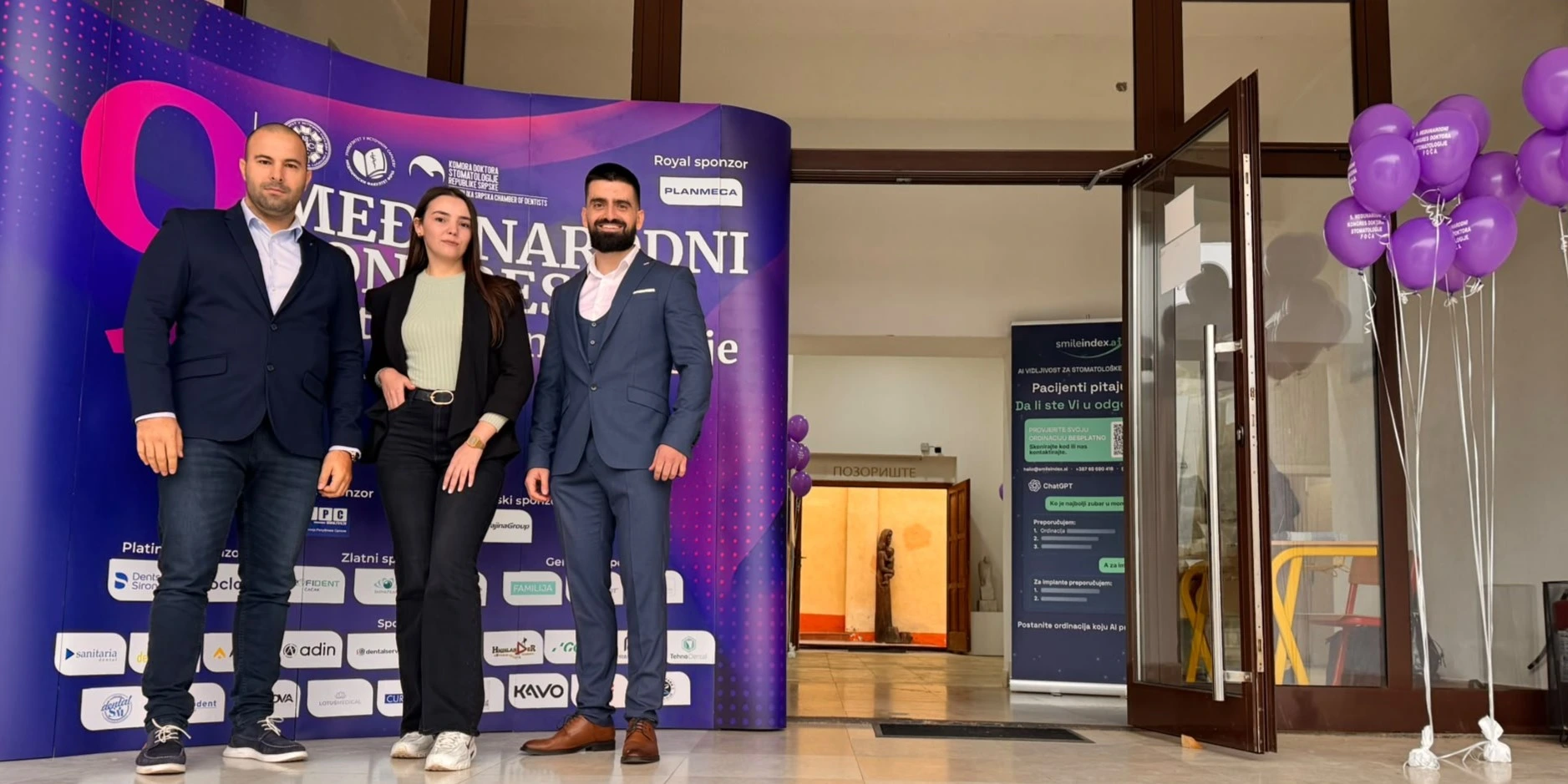
It was an honor to be part of the 9th International Congress of Dental Professionals in Foča on Saturday, September 26.
Throughout the day, we spoke with dentists from across the region at our booth about how patients search for and choose a dentist today, and what that means for practices at a time when more and more patients are asking AI.
We were especially encouraged by how open people were to discussing AI, and by the practical questions we received at the booth. We’ll address some of them in upcoming posts. We left Foča with new connections and plenty of inspiration for what comes next.
We also spoke with people from the dental-equipment industry about where AI is taking dentistry over the next few years.
Thank you to Stomatologija Foča for excellent organization, and for recognizing how important AI search is becoming for attracting new patients. Thank you as well to everyone who stopped by our booth. See also their post about the congress.
If you didn’t make it to the booth, request a free report for your practice: see who appears in AI answers in your city, along with three things we noticed.