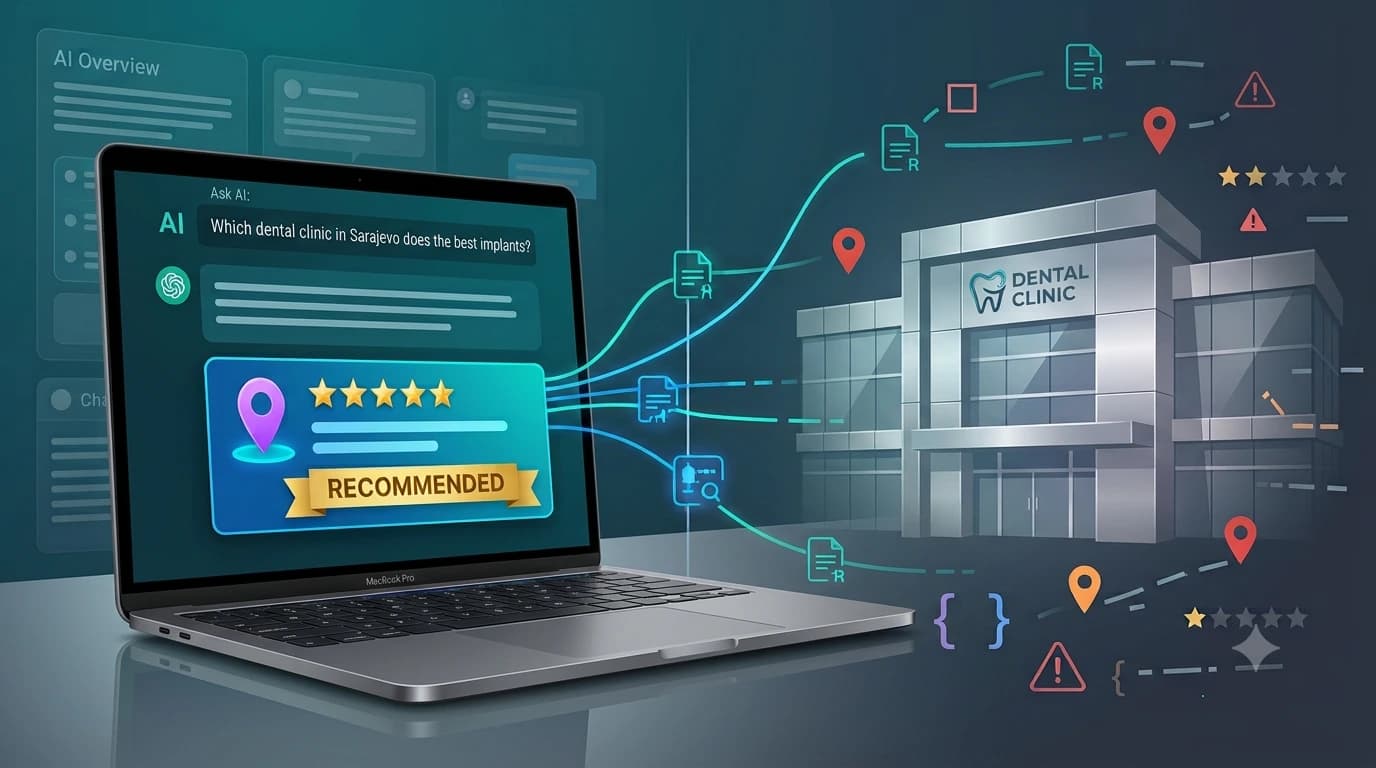
Ask ChatGPT "which dental clinic in Sarajevo does the best implants?" It will confidently give you an answer. Ask Perplexity the same thing about Belgrade or Zagreb, and it will do the same. Google AI Overviews already do this at the top of the results page — before a patient ever scrolls to your website.
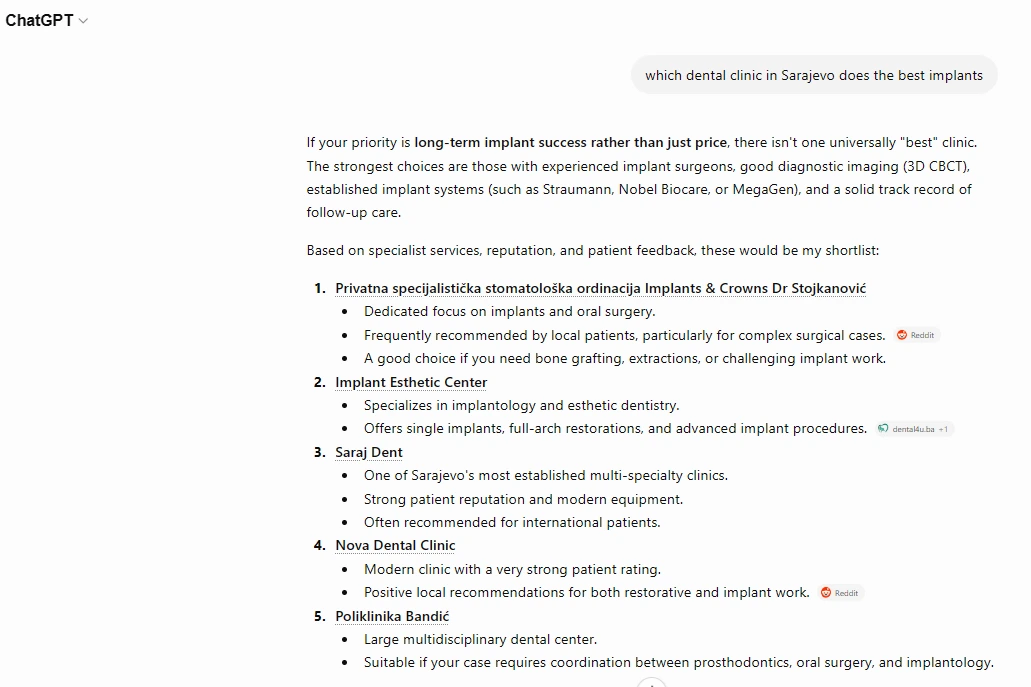
For most dental clinics in the Western Balkans, the answer that comes back names someone else.
Why AI can't see your clinic
AI search engines don't crawl the web the way Google did a decade ago. They rely on a mix of signals — structured data on your website, citations from directories and news sites, review platforms, and how consistently your practice information appears across the internet. When any of those signals are missing, incomplete, or contradict each other, the AI has no confident answer to give — so it defaults to whoever does look consistent.
Most dental clinics in our region were built with:
- A website designed for humans, not machines. No schema markup, no structured data telling AI what services you offer, who works there, or where you are.
- Google Business Profile listings that were set up once and never maintained. Wrong hours, missing services, no photos in the last two years.
- Zero presence on the health directories and citation sites that AI engines cross-reference.
- Reviews scattered — some on Google, a few on Facebook, none of them responded to.
To an AI model, that clinic looks like a data gap. It doesn't matter how good your dentistry is.
What it's costing you
Patients aren't researching the way they used to. Instead of comparing five clinics from Google results, they're asking an assistant. Whichever practice the AI mentions gets the call. The other four don't even get a chance to compete.
For dental tourism — which drives a huge share of high-value cases in Croatia, Serbia, and Bosnia — this is even more acute. A patient in Germany or Austria asking "safe affordable implants in the Balkans" is getting a short list of clinics. If you're not on that list, you don't exist for them.
Test it yourself in 2 minutes
Before you do anything else, three quick checks that tell you where you stand:
- Open ChatGPT and ask it about your own clinic — by name, and then by the query a patient would actually use ("best implant clinic in [your city]"). Note what comes back, and whether your clinic is in the answer at all.
- Open your Google Business Profile. Check that your hours are current, your service list is complete, and that there are photos from the last 12 months. This is the single biggest input into local AI answers.
- Paste your homepage URL into Google's Rich Results Test. If it finds no structured data, AI models have nothing machine-readable to work with when they try to understand what you do.
If two out of three of those come back weak, you already know why the AI isn't picking you up.
What you can actually fix
None of this requires a new website or a marketing overhaul. AI visibility comes down to a specific set of technical and content signals — schema markup, citation consistency, review structure, and content that answers the questions patients actually ask AI assistants. Get those right, and the AI starts recommending you.
That's exactly what the SmileIndex readiness score measures. We score your clinic against 100 concrete signals across AI visibility, organic search, schema markup, and citation authority. You get a clear picture of where you stand — and the specific gaps that are keeping you off ChatGPT, Perplexity, and AI Overviews.
In a single month, most clinics can realistically clean up their Google Business Profile, add basic dental-practice schema to the homepage, and consolidate reviews onto one or two platforms. That's usually enough to start appearing in AI answers for their own city — and it's a concrete place to start this quarter rather than a plan for 2028.